

Ore from the mine varied from lumps of solid micaceous haematite to coatings on quartz and/or granite base rock; it was trammed to the top of the incline and hand sorted.
Soft ore, which is the best grade, was washed off the base rock with a water jet in the top box of the washing strips. These strips, akin to those used in alluvial gold and tin workings, were simply an inclined channel down which a constant flow of water was sent, followed by a series of sand collection boxes. Although the haematite is heavier than the other minerals present, it is in the form of thin flakes which can be carried along in a flow of water. At the outflow end of each box was a ridge which held back the waste sand while the haematite flakes flowed on to the next box with the water and finally on to the settling tanks. Sand was throw back up onto the channel until no further haematite washed out.
Coarse sand, which may
contain useful ore, was sent down to the jigging box for further
processing while the fine sand was waste.
Material from the mine containing a harder grade of ore was thrown across a 1.5" screen or 'grizzly'. What passed through was sent down a chute to the stamps to be crushed in order to liberate the haematite locked in the matrix. Larger blocks were broken up with a sledgehammer so as to pass through the grizzly.
Medium sand from the washing strips and from the jigger was also sent to the stamps.
The sand resulting from the stamping washed out into a spiral classifier which carried sandy material to the top of the spiral; any remaining ore was washed out in a second small set of strips. The good ore washed straight out of the bottom of the classifier and was piped into settling tanks.
The jigging box or jigger is a simple hand powered piece of equipment for separating gravel containg ore from barren gravel. It comprises an outer box filled with water and a smaller inner box with a mesh bottom which contains the gravel to be washed. The inner box is suspended from a cantilevered arm and is jigged by dipped it vigourously in and out of the water. Haematite is heavier than the other minerals present and so gravel containing haematite settles to the bottom of the inner jigging box. The bottom layer, rich in haematite, was sent to the stamps. Washings from the jigger went to the settling tanks to extract any remaining haematite.
Concentrate in the settling tanks, once it had settled out, was shovelled into trams and sent to the Drying Shed, where it was laid to a spade depth on the heated drying floor. The dried and raked concentrate was raised by an elevator and dropped into a rotating sieve, both driven by the waterwheel.
The finished product was packed into barrels, weighed and carried out onto the loading bay to await removal usually to Lustleigh Station.
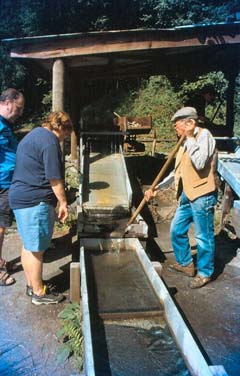
Washing strips in action. The jet washing box is in the background with a spray bar in front above the sloping trough.
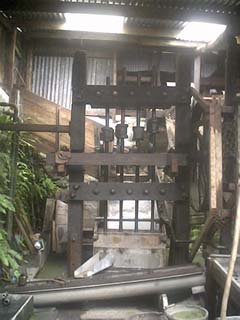
Four head Californian stamps. Lumps of material and water are fed to the rear of the stamps. Crushed material flows out the shute at the front into the spiral classifier.
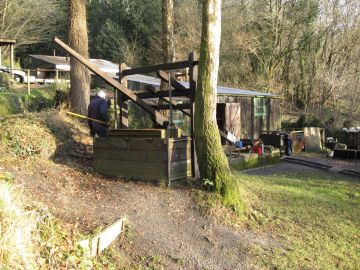
Jigging box or jigger with the mill
behind it. The washing strips are
top left.